
Share Laverne E. Woods's obituary with others.
Invite friends and family to read the obituary and add memories.
Stay updated
We'll notify you when service details or new memories are added.
You're now following this obituary
We'll email you when there are updates.
Select your format and elements to print

IN LOVING MEMORY OF Laverne E. Woods
Laverne E.
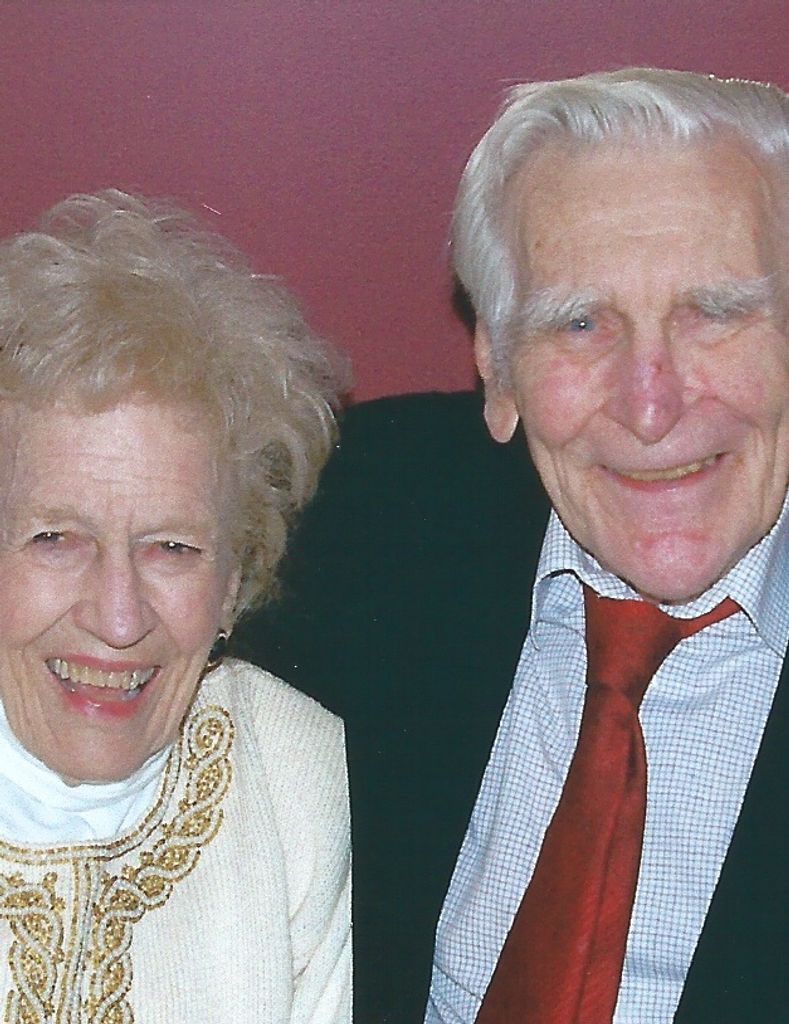
Woods
Jan 27, 1921 — Mar 12, 2016
Laverne E. Woods' Obituary
LaVerne Woods passed away peacefully on Saturday, March 12, 2016 in the V.A. Hospice unit in Bedford, Massachusetts. He was 95 years old.
Verne was born January 27, 1921 near Hazen, Arkansas. He lived with his grandfather for several years before moving to Memphis, Tennessee. Verne remembered very well the small cabin with its dog run, and the fireplace with his grandfather's rifle hanging over it.
Verne grew up in Memphis, finishing high school and starting a career with the National Biscuit Company. He met his wife, Onie Belle Patrick, while attending Memphis schools and married her on June 10, 1942. A few weeks before, on April 1, 1942, Verne joined the Army Air Corps as an aviation cadet.
Although trained as a fighter pilot, on graduation Verne was assigned to the
8th Air Force to fly B-17s as a co-pilot. After further training he was sent to the 91st Bomb Group, 324th Squadron, based in Bassingbourn, England in early September 1943.
On Verne's 13th mission over southwestern France, his plane, the Black Swan, was shot down by two German FW 190 fighter planes. His co-pilot was killed instantly in the attack, but Verne and seven of the other eight crew members parachuted safely. With the help of French farm families he was able to travel on a bicycle to a point close to the Spanish border before he was betrayed to the Gestapo. After spending a month in a Paris SS prison, mostly in solitary confinement, he was transported to a Luftwaffe POW camp in north Germany until the War's end. As the Russians approached from the east, Verne and a fellow prisoner walked many miles west to the advancing British lines.
During the few months before the Japanese surrendered in August 1945, Verne volunteered to serve as a fighter pilot in the Japanese Theatre, but he was not called before the war ended.
After the war Verne enrolled in the University of Iowa, graduating in 1950 with a degree in Journalism and a Master's degree in Economics. Verne and Onie then moved to Washington where he applied for a job as an economics and science writer for the newly established National Production Authority. He was the third person hired by the agency, which quickly grew to more than 5,000 employees. His work consisted of preparing press releases, brochures, reports to Congress and writing speeches for the Director of the Authority.
When the war in Korea ended, Verne accepted a position at M.I.T.'s Lincoln Laboratory, where he wrote articles for scientific publications. He and Onie moved to Lexington and into their home for the rest of their lives. He continued similar scientific writing at the Air Force Cambridge Research Laboratory, also at Hanscom Field, until it was absorbed into the Air Force System Command in 1971.
In semi-retirement Verne volunteered to work for Brandeis University, caring for their laboratory animals for several years. He taught a part of a Brandeis science course about caring for animals in laboratories.
Verne was a superb athlete, excelling at tennis and skiing. He was President of the Lexington Tennis Club for several years, and he and Onie went on many skiing trips in the United States and Europe. He also continued to write extensively for his own amusement. He completed a series of thoughtful essays, "Letters to Myself", and a booklet, "Death of the Black Swan". He was exceptionally well-read, especially in economics, science and politics. He was always a great conversationalist after his natural reserve eased somewhat, and especially when Onie was around.
Verne's life suffered a great deal after Onie passed away on November 27, 2014. May they both rest in peace.
A memorial service will be held at a later date this spring.
Arrangements are under the care of the Dee Funeral Home of Concord.
To send flowers with our preferred florist or plant a memorial tree, please visit our flower store.
Laverne E. Woods' Guestbook
Visits: 13
This site is protected by reCAPTCHA and the
Google Privacy Policy and Terms of Service apply.
Service map data © OpenStreetMap contributors